

Subscribe to Our Newsletters
BEEF Magazine is the source for beef production, management and market news.
The common rap on Bos indicus is they can’t grade, but Pine Ridge Ranch claims its cross not only provides heat tolerance but provides tender carcasses at 85% Choice, with no Yield Grade 4s and 5s.
July 25, 2012
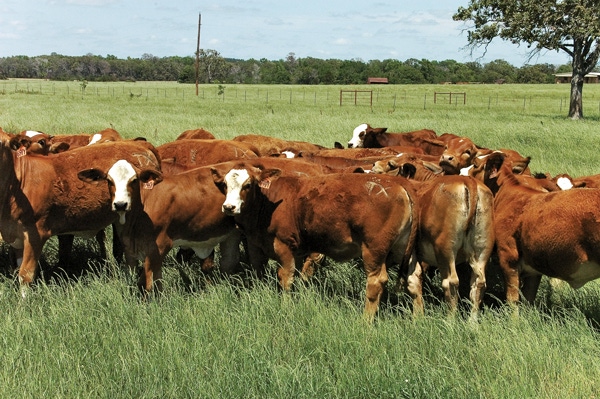
It’s a typical East Texas summer day – about 110° and sticky. But you won’t see any of Bill Travis’ cattle standing in a stock tank to cool off. His Bos indicus cross is built for heat. And their quality tops 80% Choice.
Travis and his wife Jane have been in the Simbrah breeding business since 1981. Their Athens, TX, operation, the Pine Ridge Ranch, takes advantage of the breed’s ability to perform in heat. Its some 1,400 acres of rolling hills pasture and timber provide a combination of native and cool-season grasses sown for year ’round grazing, with some hay supplementation in winter.
 “The specs we wrote in 1981 are still accurate,” Travis says. “Our original goal was to produce a 1,200-lb. steer at 12 months of age. Now, we push for a 1,300- to 1,400-lb. steer in 14-16 months, without the use of growth promotants, because our cattle marble later. Our goal is to obtain 65% red meat and a tender carcass.”
The Travises’ seedstock program grew out of their determination to develop an animal ideal for warm weather. “About 65% of the world’s grazing areas are located within high-temperature regions,” Travis says. “We produce cattle that are environmentally bred to thrive in hot-weather grasslands that cover most of the world’s major beef-producing areas. In hot areas of the world, virtually every animal in nature has a dark hide. Reddish color hair is predominant, except for the Bos indicus and the zebra.”
After a decade of commercial ranching with various crosses, the Travises set their sights on Simbrah and haven’t looked back. To qualify as a purebred Simbrah, the animal must be 5/8 Simmental and 3/8 Brahman.
“To help produce a growthy calf, we use Fleckvieh Simmental bulls bred to Simbrah cows, which have good bags and udders to promote good milking,” Travis says. “Calves have good heat tolerance, longevity and benefit from heterosis.”
Anyone who knows Travis knows his market for selling breeding stock stretches beyond the southern U.S. And they know he’ll stand up for his Simbrah and other eared cattle.
Africa, Australia, Central and South America, Mexico and Asian countries are seeing more producers and breeders who are eager to improve their production efficiency and their beef quality, Travis says. They want cattle that can perform efficiently in hot climates.
“There are still a lot of people who think our type of cattle are low in quality,” Travis adds. “They don’t think they’ll perform at the ranch, at the feedyard, or at the packer. But we’ve shown time and again that, through breeding and research, we’ve developed an animal that consistently produces a high percentage Choice, is tender, and no Yield Grade 4s or 5s.”
Texas A&M University (TAMU) and the American Brahman Breeders Association recently hosted a Beef Improvement Federation annual meeting. Part of the impetus was to change that perception of eared breeds, Joe Paschal, Texas AgriLife Exten-sion livestock specialist in Corpus Christi, explains.
 “Tours of American breed or ‘eared’ breeders exposed many northern cattle producers, researchers and Extension specialists to what these breeds looked like and how they could perform in various environments,” Paschal says. “Many still had the idea that Brahman-influenced cattle resembled rodeo stock. We completely changed their mind.”
Paschal says the Travises have been among ranchers and seedstock operators who took advantage of TAMU Ranch to Rail steer feed-out programs, and later Ranch to Rail through New Mexico State University. The Travises weren’t new to cattle feeding but were interested in how their cattle performed against other breeds, he says.
Started in 1991, these programs offered producers the opportunity to see how their calves would perform in the feedyard and at the packer. They also showed the importance of a solid vaccination and weaning program at the ranch in order to enhance animal health.
“Travis had several types of Simmental and Simbrah crosses in the Ranch to Rail – South Program,” Paschal recalls. “Those cattle were really growthy, gaining 3+ lbs./day and finished Choice and high Select, with very little if any sickness or treatment costs.”
That was early in the history of Pine Ridge Ranch. Travis took what he learned from those initial feed-out results and gradually improved his production.
“He is one who took the data home and did something with it,” Paschal says. “He made his selections based off those and other performance records.”
The traits sought by Travis are virtually the same ones he and his wife listed over 30 years ago. They want heifers that calve at two years of age, and cows that calve every 12 months. They want good calving ease, and calves with a low birth weight and high growth rate (other goals of their program are listed at www.simbrah.com).
“We DNA test on all donor cows and bulls to measure as many traits as possible,” Travis says. “And we ultrasound every yearling to measure backfat and marbling.”
Jane, who is as involved in the operation as Bill, documents data on each animal. And she’s always seeking more information. “We feed out all steers and get carcass data back so we can correlate their performance with their bloodline,” she says.
Bill is an engineering graduate, with a Harvard University MBA with concentration on production and finance. He uses that engineer mindset in the cattle business. Every aspect of a heifer, cow, bull or steer is considered. “We have a system to measure the growth-to-feed conversion out of our bulls,” he notes.
He is a firm believer that all breeds of cattle are good; they just need to fit their environment. “I don’t feel our cattle need to go much further north than Oklahoma or Kansas. They are bred for performance in warm-weather climates,” he says.
When packers started accepting heavier carcasses without discounting them, cattle that marbled at heavier weights benefitted. Among them were Bill Travis’ Simbrah.
“It really helped us when packer started taking a bigger carcass weight,” the Athens, TX, seedstock producer says. “Before the carcass specs were increased, our cattle graded about 52% Choice,” he says. “That’s because our cattle marble at over 750 lbs. of hot carcass weight. Now, we average well over 80% Choice.”
Travis and his wife Jane feed out all males they don’t hold to sell or use as sires. They obtain as much data as possible from the steers. For a set of 23 steers that were finished at Graham Land & Cattle Co., a feedyard in Gonzales, TX, in 2011, the average hot carcass weight was 801 lbs.
All but two graded Choice. The two that graded Select were from the two lightest carcasses, 660 lbs. and 730 lbs. Nineteen were USDA Yield Grade (YG) 2, three were YG 3 and one was YG 1. Out of more than a dozen feeding sessions since 2000, “there have been very few YG 4s or YG 5s,” Travis says.
“Our product is very tender, with shear force tests in the 5.3-lb. range,” he says. “And we believe we have built a ‘breeding plant’ that basically eliminates YG 4 and 5 cattle.”
Texas AgriLife Extension livestock specialist Joe Paschal says Texas A&M University feeding trials have consistently shown that cattle with Simmental and Simbrah influence have performed well on feed in southern feedyards.
“There had been some concern over (high) medicine costs for these type cattle on feed,” he says. “But we didn’t see those problems in southern feeding areas.”
Larry Stalcup is a freelance writer based in Amarillo, TX.
You May Also Like
Current Conditions for
54°F
Partly Sunny
Day 74º
Night 58º
Enter a zip code to see the weather conditions for a different location.

.png?width=300&auto=webp&quality=80&disable=upscale)