-
Every head of cattle makes numerous stops and sees several industry sectors – sometimes more than once – from pasture to plate. You can read the whole story here: http://j.mp/P337jm.
-
As of Jan. 1, 2012, there were 29.9 million beef cows in the U.S., 3% fewer than the year before and the fewest since 1962. The total cowherd (dairy and beef) on Jan. 1 was 90.8 million head, 2% less than the prior year and the smallest total cowherd since 1952. Read the whole story here: http://j.mp/P337jm.
-
The four largest beef packing organizations accounted for 85% of the steers and heifers slaughtered in 2010, according to the 2011 annual report from USDA’s Packers and Stockyards Program. Read the whole story here: http://j.mp/P337jm.
-
The beef that’s not exported winds up on the dinner plates of a current U.S. population numbering 313.9 million people. In round numbers, per-capita beef supply last year was about 57 lbs. Read the whole story here: http://j.mp/P337jm.
-
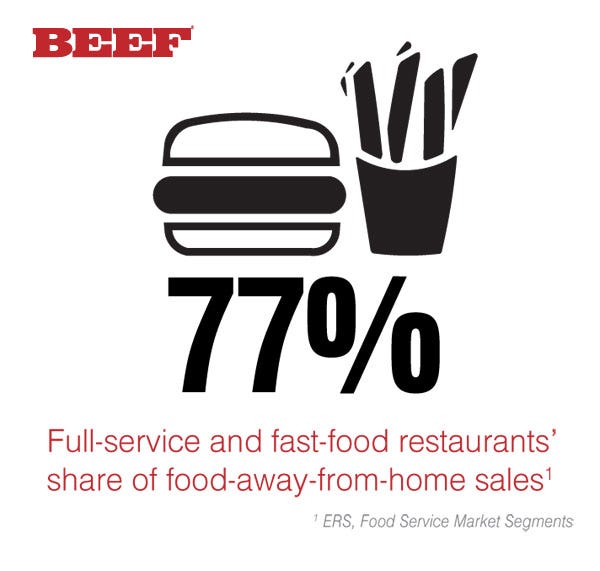
There were 36,569 supermarkets in 2011 with annual sales of $2 million or more, according to the Food Marketing Institute, and 580,852 U.S. restaurant units in the fall of 2011, according to The NPD Group. Read the whole story here: http://j.mp/P337jm.
-
-
In round numbers, 17 of the most populous beef breeds registered 765,038 bulls and females in 2007, according to the National Pedigreed Livestock Council. (That’s the most recent year in which all of the seven most-used breeds reported registration numbers. The movement of some breed associations to whole-herd reporting has made year-to-year comparisons more tenuous.) Of those registrations, 86% came from seven breeds, which speaks to the ongoing breed consolidation that began at least 15 years ago.
-
-
-
-
The average age for commercial farm operators is 55, with 14% of them indicating they planned to exit within five years.
-
Read more about the beef stocker industry here.
-
The 2008 BEEF National Stocker Survey (NSS) found only 17.2% of stocker producers were exclusively in that segment of the cattle business. Of those, 52.3% said stocker cattle accounted for 50% or more of their annual gross income.
Read more about the beef stocker industry here. -
Read more about the beef stocker industry here.
-
Read more about the beef stocker industry here.
-
Read more about the cattle feeding industry here.
-
Read more about the cattle feeding industry here.
-
Read more about the cattle feeding industry here.
-
Read more about the cattle feeding industry here.
-
Read more about the packing industry here.
-
Read more about the packing industry here.
-
Read more about the packing industry here.
-
Distributors have gained significant market share over the years. In 2005, the top nine distributors had 35% of total food service sales. By 2010, the top distributors reflected 46% of total food service sales.
Read more about the distribution of beef here. -
From the packer level, beef can take varied paths.
“It’s just so important that each step in the supply chain is done right. It’s critical that each one does their job right so the next one in line can concentrate on what they do,” Jim Henger says. “Everyone relies on everyone else before them and after them to do the right thing.”
Read more about the distribution of beef here. -
Read more about the retail beef sector here.
-
Read more about the retail beef sector here.
-
Read more about the retail beef sector here.
-
Read more about the food service sector here.
-
Read more about the food service sector here.
-
Read more about the food service sector here.
-
Read more about the food service sector here.
-
Read more about the food service sector here.
-
Read more about the food service sector here.
-
Read more about the food service sector here.
Fragmentation is both the blessing and the bane of the U.S. beef cattle industry. BEEF magazine is embarking on a year-long journey to explain the different industry sectors and their roles in the production process from the seedstock producer to the end consumer. Along the way, we will also examine the technology and management breakthroughs that have allowed each sector to build efficiency, and the outlook for their future.
As this gallery shows, every head of cattle makes numerous stops and sees several industry sectors – sometimes more than once – from pasture to plate.
Read the whole story "Connecting The Dots" series.