

Subscribe to Our Newsletters
BEEF Magazine is the source for beef production, management and market news.
The importance of a dam’s early-gestation nutrition, both for the short and long term, is drawing a lot more attention.Early gestation is when the placenta, which carries nutrients to the fetus, develops; it’s also when the vital organs develop.
October 1, 2011
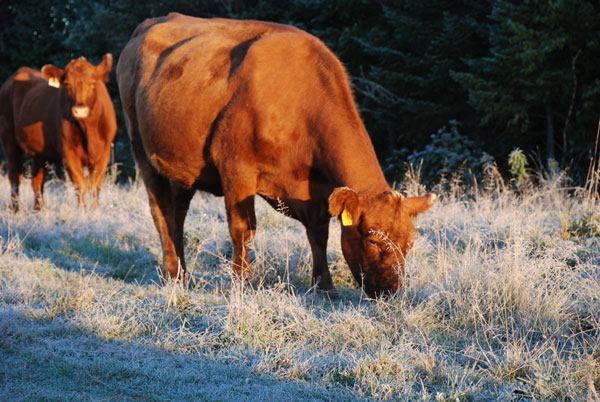
What a pregnant cow eats during early gestation – both quantity and quality – can have long-lasting effects on her calf. That’s a concept, however, that appears to be little understood or practiced by many producers.
“Many producers don’t think a tiny fetus needs much nutrition, and ranchers tend to supplement cows late, during the last trimester of gestation, in order to raise body condition scores before calving,” says Stephen P. Ford, director of the University of Wyoming (UW) Center for the Study of Fetal Programming. However, he explains, that might be too late.
“We saw this very clearly after an extended drought here in Wyoming. The quality of calves born during those years was significantly reduced, even though the cows’ body condition at calving was close to what it should have been,” Ford says.
Early gestation is when the placenta, which carries nutrients to the fetus, develops; it’s also when the vital organs develop. “If cellular composition is altered, even if you increase fetal size during late gestation with supplemental feeding, the composition will still be abnormal,” he says.
Work with cows and sheep
Ford has studied the impacts of nutrition in cows and sheep as it affects growth and development of the fetus and post-natal development. His purpose is to quantify the effects of what often happens in the West with lack of precipitation in summer and fall.
Females on a range/forage-based diet tend to be undernourished during the first half of gestation, he explains. Forage is dry and winter-feeding programs haven’t always started or are inadequate.
Ford’s work includes a study in which a group of UW range beef cows was underfed from day 30 to day 125 of gestation (see red section in Figure 1); that’s the period when fetal skeletal muscle fibers, pancreas, kidneys and brain are developing. One group of cows was fed 60-70% of requirements from day 30 to day 125, while the other group was fed a normal maintenance ration.
At day 125, fetuses were collected from some of the undernourished cows, while the remainder of the undernourished group was fed to bring them up to a condition level equal to that of the normal group by day 220 of gestation. Ford says this is analogous to what happens on ranches when producers supplement thinner cows during late gestation.
Ford says his team learned that cow age affects how cows and fetuses respond to under-nutrition. While cows were randomly assigned to the two groups, his team observed two distinct responses in undernourished cows. The response of first- or second-calf heifers was different than that of cows that had produced three calves or more.
For instance, the fetuses in undernourished young cows at mid-gestation were significantly smaller than fetuses of control-fed cows, due to intrauterine growth retardation. That’s because cows are still growing up to four years of age, and some nutrition is directed toward continued growth of the cow’s body rather than into her fetus, he says.
In contrast, older, undernourished cows had fetuses near normal in size at mid-gestation.
“In the growth-retarded fetuses from young cows, we found enlarged hearts, altered pancreatic and kidney development, and increased brain size. The brain tends to grow at normal rate even if the fetus is undernourished, because the brain is vital for fetal survival. We found a much heavier brain-weight to body-weight ratio in growth-retarded fetuses,” Ford explains.
He also found decreases in skeletal muscle fiber development in undernourished fetuses. Since embryonic development of muscle tissue is complete by mid-gestation, this could result in decreased skeletal muscle mass in post-natal development, which is important for beef producers, he says.
“We let some fetuses go to term and discovered the insidious nature of this situation. All calves were born at similar weight, whether they came from controls or undernourished (and “caught up”) animals. So the producer would never know, based on the calf’s weight, whether the fetus had been deprived of nutrition at a critical point during gestation,” Ford says.
What’s more, the effects on calves of nutrient-deprived cows were long-lasting. Though they seemed normal at birth, these calves weren’t as able to remain healthy or perform optimally.
Early-deprived fetuses – even though equalized in weight with fetuses of control cows – had half the normal number of nephrons in their kidneys. Nephrons are important because they help remove toxins and metabolites from the blood for excretion, Ford explains.
“Once these animals enter the feedlot and go on full feed, their kidneys aren’t functioning fully and can’t filter out toxins efficiently. This affects their growth rate and health,” he says.
The researchers also saw decreases in skeletal muscle mass in nutrient-deprived offspring as they grew, as well as increases in adipose (fat) tissue. Early fetal malnutrition seemed to shift carcass characteristics to fatty and less lean.
“Most people have heard about genotype and DNA, and that a particular set of genes makes an animal what it is. But, it’s been determined recently that the intrauterine environment can alter gene expression patterns of an animal after birth, a process called epigenetics. These changes in gene expression alter the phenotype of an animal and thus its quality,” Ford explains.
So, even though two animals may have identical genotype, if gestated in females on different nutritional regimens, they turn out different.
“They may look the same at birth but, once in the feedlot, one may get sick and the other may not. Life doesn’t begin at birth. The animal undergoes many more changes before birth than it ever will after birth,” Ford says. “If we don’t enable the fetus to develop optimally and express normal patterns of organ and tissue development, we alter the composition and quality of those organs. No matter what is done to the animal after it’s born, we can’t fully correct this early damage.”
Thrifty phenotype & obesity
If the normal nutritional requirements of cattle and sheep are maintained after birth, many of these concerns won’t be noticed,” Ford says. “It’s when we start feeding them all they will eat, that we see problems.”
The biggest effect in response to their under-nutrition environment is increased appetite. With access to full feed, they eat more, which can result in health problems because they’re prone to insulin resistance and obesity, Ford says, something borne out by his work with sheep.
“Adult offspring from undernourished ewes spend the same amount of time at the feed bunk, but eat significantly more. Utilizing a Grow-Safe computerized feed measurement system, we measured how long and how much they ate. These animals ate for the same amount of time as other animals but consumed 50% more feed. There was no resulting increase in feed efficiency, however; they just put on more fat, both internal and subcutaneous.”
“You can imagine how this affects them in a feedlot. We don’t know yet how these problems might affect cows in a breeding herd,” Ford says.
That body memory remains with an animal or person throughout life. The body tries to gain weight whenever it has the opportunity. Predisposition to increased appetite and fat tissue is linked to thrifty phenotype.
“Fetuses deprived of nutrients in utero expect to be born into an environment short of food. They consume and accumulate significantly more nutrients as fat than do control offspring when exposed to unlimited food. Their body is programmed to accumulate and store nutrients whenever available,” Ford explains.
Pregnant cows should be maintained in a range of normality. Under-nutrition during drought can be a problem. It’s also a problem if you overfeed pregnant heifers, or bought pregnant heifers from a feedlot, he says.
Rich McCormick, a University of Wyoming professor of muscle biology, says the initial concern with bovine nutrition during early pregnancy came from observations in humans.
“Near the end of World War II, the Allies dropped troops beyond German lines in an effort to secure bridges over the Rhine River. It was a military disaster,” McCormick says, as many soldiers were killed or captured.
“When that operation was over, most of our troops were in German prison camps and the Germans halted food shipment into that part of the Netherlands. People were down to about 400 calories/day, eating anything possible,” he says.
The Dutch kept good medical records and, about 20 years ago, David Barker, a researcher at the UK’s University of Southhampton, followed the medical history of some of these people, McCormick says. This included women in various stages of pregnancy during this period, as well as their offspring born in 1944-45.
“Later in life, offspring developed many problems, including serious heart conditions, kidney disease and diabetes. Current research is studying what happens as a result of conditions the fetus undergoes in utero,” McCormick says.
Some problems depend on stage of pregnancy when nutritional status of the mother is adversely affected, as well as the severity of the nutritive restrictions.
“Here, we started looking at the problem of maternal obesity, especially in humans. My area of expertise is connective tissue. Maternal obesity can severely impact offspring when they grow up. Having an obese mother may be worse than having nutrient restrictions,” McCormick says.
“What interests me in the offspring of obese humans and cattle is the inflammatory response that is initiated. This has implications for connective tissue, skeletal muscles and the heart,” he explains.
“In cattle, we find deposition of connective tissue fibrosis in the heart. What I’ve worked on for most of my career is collagen cross-linking. All evidence suggests that connective tissue is impacted during early fetal programming – maybe even to the point of contributing to tougher meat or variability in meat tenderness from different animals. This is a big issue in the beef industry,” he says.
Do the effects of fetal programming reach generationally?
Stephen P. Ford, director of the University of Wyoming’s Center for the Study of Fetal Programming, thinks so.
“We studied F1 offspring from obese ewes after we did feedlot trials. We put obese females on a maintenance diet and got them back down to body condition of pre-feeding levels and bred them.
“We had two groups of adult female offspring (from fat mothers and from control mothers) and fed them maintenance diets all through pregnancy. We found ewes born from obese mothers, even though they themselves were on a normal diet during pregnancy, exhibited insulin resistance, as well as a marked increase in glucose and insulin concentrations in their blood. They had more glucose to shunt into the fetus,” Ford says. In other words, they were passing extra nutrition to the next generation.
When the F2 offspring were born, they exhibited a marked increase in internal fat, as their mothers had, suggesting the F2 generation was perpetuating the same health concerns. Thus, there may be transfer of obesity across generations.
“We don’t know how many generations this might go, once you program these problems. Females born from obese mothers are more insulin resistant because their pancreas has been altered. They feed their own fetus more, even though they are eating less,” he explains.
Another experiment was designed to look for phenotypic differences between two flocks of sheep of similar genotype (Western Whiteface ewes), which had been a single flock maintained by the University of Wyoming 30 years earlier.
“They’d been separated into two flocks, each maintained under markedly different management and feeding systems. One flock was purchased and taken to the Red Desert near Baggs, WY. They were in a nomadic range operation and hadn’t received any supplement. Lambs produced were kept as part of the range flock. The other flock remained at UW and were typical university sheep – fed too much and leading a sedentary life,” Ford says.
Ford bought ewes from each flock and undernourished both groups during early to mid-gestation.
“When I collected fetuses at mid-gestation, I found the fetuses of the UW sheep had significant intrauterine growth retardation. The pancreas was affected, heart enlarged, etc. When offspring from these animals were born, I raised them to adults and put them on full feed. They had increased appetites, became insulin resistant, and developed hypertension,” he says.
“In contrast, fetuses collected from the nutrient-restricted nomadic range flock were of normal weight and body composition, even though they’d been significantly undernourished during fetal development. Their placentae exhibited an altered phenotype and became more efficient in delivering nutrients to the fetus when we reduced the ewes’ feed intake. These undernourished nomadic ewes over a period of 30 years (about 4-5 generations of sheep) had evolved to where they could eat much less feed and yet grow normal, healthy lambs. And, when those lambs were born, they did not show insulin resistance or any unhealthy symptoms. They grew normally,” says Ford.
This suggests that animals can adapt to their environment over time. Producers generally try to buy animals from a similar type of operation, so the cows will fit their ranch environment.
“If you buy animals from another production environment, they may not adapt to your environment for several generations. Our studies suggest that by getting animals that were raised in a similar production setting, there’s more chance they will do well in yours. Epigenetically they are able to adapt their phenotype to a particular production environment, and it takes time to adapt to a markedly different environment,” he says.
You May Also Like
Enter a zip code to see the weather conditions for a different location.


.png?width=300&auto=webp&quality=80&disable=upscale)
