-
Darin Mann displays the one-acre park that lies in the heart of M/M Feedlot. He says visitors often surprised by the park, which is a popular hosting spot for field trips by area school kids. “We see it as a fantastic opportunity for these kids to learn firsthand, and experience, where their food comes from,” Mann says.
-
This is the headquarters building for M/M Feedlot in Parma, ID, which is owned and operated by father-son team, Kent and Darin Mann. “You can’t always be the biggest, but you can always be the best, and that’s our goal here,” says Darin, the third generation on the operation. “We feel good about what we’ve done but we always know there’s room to improve and we look forward to being challenged to do just that.”
-
M/M Feedlot in Parma, ID, a dairy heifer-development enterprise with a one-time capacity of 12,500 head. The operation supplies replacement heifers to six large dairy operations in the Northwest. The calves come to the feedlot at six months of age; at 12-13 months of age, they’re bred artificially to their owners’ specifications. At 20 months of age and about seven months pregnant, the heifers are returned to the dairies, where they give birth and enter the milking string. Their calves will return to M/M Feedlot and the cycle continues.
-
The composting program results in corrals getting cleaned year-round and the concrete pads around the feed bunks and water troughs weekly. Cleaning is done with a tractor and a box scraper, moving the manure into concrete holding areas. Once the holding area is full, the manure is transported to one of two composting areas on either side of the feedlot.
-
An internal temperature of 131° over a 15-consecutive-day period is required in the windrow to kill the E. coli, salmonella, weed seed and pathogens present in the manure. Temperature is monitored daily by inserting a 4-ft.-long probe into the windrow every 200 ft. during the first 15 days of the composting process. The readings help determine if the windrow needs to be turned to add more oxygen, or if water should be applied to help further activate the process.
-
M/M Feedlot uses a Wildcat 616 towable straddle compost turner to invert their rows of composting material. The unit’s 275-hp engine can process up to 3,000 tons/hour of compost, a capacity that allows the feedlot to completely turn all their windrows within one day.
-
This is the business end of the compost turner, which mixes and aerates the composting windrow. It features a horizontal steel drum with flails that spin rapidly to turn the compost windrow and mix fresh air into the pile. Drum-style turners are ideal if facility space is not an issue.
-
At the end of the 120-day composting process, the material is screened according to customer specifications. Ninety-five percent of the compost produced is sold to area farmers and is screened to 3/4-in. The rest is sold to landscapers, nurseries and garden centers and is processed using a 3/8-in. screen.
-
Concrete scrape alleys and storage boxes allow M/M Feedlot to keep its pens clear of manure. This not only helps control odor aids in fly control because they remove the environment that flies like. The manure is composed on site, with the material gong to farming operations throughout the area.
-
Composting is an effective manure management tool that reduces volume, kills pathogens and weed seeds, and also improves soil health and fertility. The windrows are aerated periodically to inject fresh air into the pile, removing the waste gas. Fresh air contains oxygen that feeds the beneficial composting bacteria and thus speeds the composting process.
-
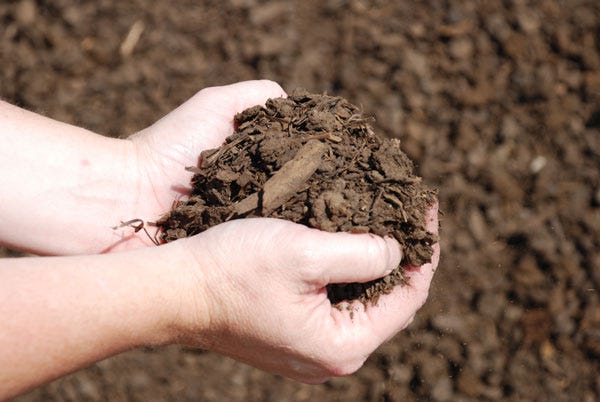
Finished composted material at the M/M Feedlot in Parma, ID. Darin and his father Kent sell the compost for $13.50/ton, which Darin says is much cheaper than the true nutrient value. “We never intended for the composting operation to be a revenue generator for our feedlot – we did it because it made environmental sense for our feedlot. However, we’ve been surprised with the demand, which has allowed us to turn a small margin.”
-
Darin Mann, who along with his father Kent, owns and operates M/M Feedlot in Parma, ID, is the third generation to work the farming operation begun by his grandfather.
-
At the center of M/M Feedlot in Parma, ID, lies a one-acre park, replete with attractive landscaping, a windmill and gazebo. M/M Feedlot was the Region V semifinalist for the 2012 Environmental Stewardship Award, and the operation regularly hosts field trips by school children, as well as government officials from the local, state and national levels.
-
Darin Mann and his son Trevor pose atop one of dozens of compost rows that begin as 6-ft.-tall, 16-ft.-wide windrows about 800 ft. in length. Typically, the Manns have a total of 40 windrows under management. The composting process takes about three months for completion, depending on temperatures.
When Darin Mann decided his future lay with the family feeding and farming operation in Parma, ID, he and his father Kent knew M/M Feedlot had to expand. One big challenge was how to dispose of the manure produced by an additional 4,000 head. Their resolution wasn’t more land, it was less manure – via composting. Read the complete feature on the Manns here.