Subscribe to Our Newsletters
BEEF Magazine is the source for beef production, management and market news.
Branding is still the best defense against cattle rustling, experts say.
March 27, 2012
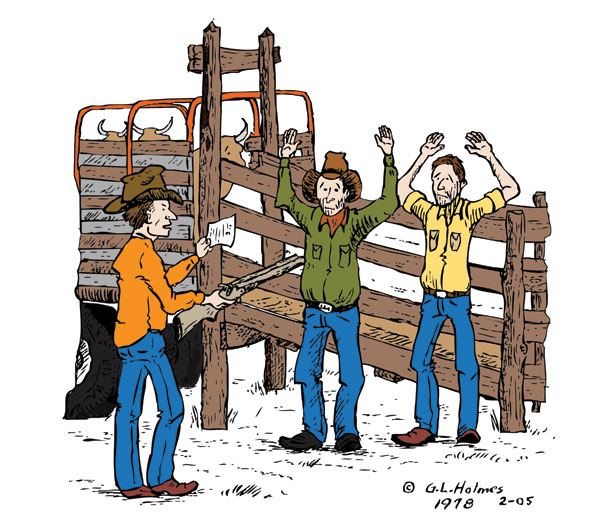
Today’s cattle rustlers usually aren’t as bold as the gun-slingers of the Old West; you can’t hang them from the nearest tree, either. In fact, Rodger Huffman, Oregon Department of Agriculture (ODA) livestock inspection and predator control programs manager, says few cattle thieves these days ever stand trial.
“More often than not, the victims know the people stealing from them – relatives, neighbors or hired help; they are typically not random thefts,” he says. “Victims almost always say they don’t want to prosecute, they just want their livestock back.”
A common way for cattle rustling to occur, Huffman says, is when cows stray onto a neighbor’s property and the neighbor holds the animal and raises calves from her. Many times, the cows “mysteriously” return to the owner a couple of years later.
Absentee ranch owners are also at risk for cattle theft.
“Sometimes, we’ll find that a ranch manager doesn’t brand a certain percentage of the calves and claims them as death loss to the owners. In fact, the manager is peeling off those young calves, and selling or trading them,” he says.
Stolen cows are usually used for breeding purposes or hamburger, but Huffman says stolen calves are typically sold via Internet cattle auctions or classified ad websites like Craigslist. They’re also sold directly to feedlots, as most feedlots don’t require brand inspections until the cattle leave the feedyard.
The best defense
Branding, Huffman says, remains the best defense against livestock theft. He reports that 83% of Oregon producers brand calves – down slightly from 90% in years past. Hot-iron branding, although not mandatory in Oregon, is permanent. Other methods currently available for marking cattle are alterable or removable.
As a result of brand inspections, in 2010, 846 animals were impounded at Oregon livestock auctions until ownership could be proven.
“Some never can prove ownership, and end up as theft investigations,” Huffman says. “In most cases, the people trying to sell them probably should have known they were in with their herd; in fact, they probably did, but when we do the brand inspections and identify them, the typical response is ‘oh, I didn’t know that was there.’ If we were to classify situations where we think they should have known better – it’s in the hundreds.”
As far as out-and-out cattle nabbing from properties, Huffman says it happens, but not as often. In this situation, most producers won’t even realize the theft has taken place until the cattle are gathered from open range.
That was the case for Skinner Ranches in Oregon’s Malheur County. Operating on nearly 10,000 square miles of open range, of which 72% is public land, Bob Skinner says they operate in the most remote area of the lower 48 states. The Skinners graze cattle on Bureau of Land Management (BLM) ground stretching from eastern Oregon’s Jordan Valley to the Nevada state line.
About two years ago, Skinner says he came up short 200 head when he pulled his Double S brand cattle off the open range, far more than normal death loss would account for. He soon discovered that many of his neighbors also had large numbers unaccounted for.
“Cattle are big animals, they don’t evaporate overnight,” he says. “Carcasses of dead animals will stay in the area for a long time. We searched by airplane, local deputies searched, no one could find any sign of them. It was a serious problem. We got together with other ranchers and decided to do something.”
The Malheur County Sheriff’s Department stepped in and Skinner says they put so much pressure on the area that cattle rustling, for the most part, stopped.
Malheur County Sheriff Brian Wolfe says slowing down cattle theft in the area was a team effort by several different agencies, including BLM, Oregon State Police, Oregon Department of Fish and Wildlife, and the local ranchers who participated in meetings with counterparts in Idaho and Nevada.
Wolfe says his department increased backcountry and aircraft patrols. And, local producers who own aircraft, including the Skinners, fly a deputy over the area several times a week. Funding from BLM helps pay for the flights and the remainder of the costs come out of the Malheur County budget.
About 63 search-and-rescue volunteers also perform backcountry and livestock patrols using county vehicles and ATVs, up to seven days/ week.
Whenever other areas such as highway patrols are fully covered, Wolfe says full-time deputies are rerouted to the backcountry roads.
The Sheriff’s Department developed cards for ranchers to fill out with license plate numbers, dates and times when they spot an unattended vehicle in grazing areas. The card includes a section that can be torn off and placed on the vehicle’s windshield stating that the vehicle had been observed by the Malheur County Sheriff’s Department.
Many producers have winter grazing permits so the air and land patrols take place year around.
Several motion-sensing cameras have also been set up to monitor areas where gates have been previously left open or vandalism to private property has taken place, and in areas where small bales of hay have been stolen. Hay theft, Wolfe says, hasn’t been a huge problem, but it does happen, usually 4-5 bales at a time.
As added incentive, pledges from livestock producers, which as of December 2011 totaled $63,000, are being offered as a reward for information leading to convictions.
Although the incidence of cattle rustling has lessened – from several hundred head to the occasional 10-15 – Wolfe says everyone remains diligent.
“It’s best to use preventive methods rather than react to the crime,” he says. “An ounce of prevention is definitely worth a pound of cure.”
Here are 14 tips provided by the Texas & Southwestern Cattle Raisers Association to prevent property theft:
1. Display a sign from your state cattlemen’s association on gates and entrances.
2. Lock gates.
3. Brand cattle and horses, and make sure the brand is recorded.
4. Put your driver’s license number on all saddles, tack and equipment.
5. Count cattle regularly.
6. Video horses and tack, and keep complete descriptions on file. Establish an organized proof-of-ownership file to save time in the recovery process.
7. Vary feeding times.
8. Be cautious about who has keys and combinations.
9. Park trailers and equipment out of view from the road.
10. Keep tack rooms and saddle compartments on trailers locked.
11. Don’t feed in pens.
12. Participate in neighborhood Crime Watch programs.
13. Don’t build pens too close to the roadway.
14. Never leave keys in tractors or other equipment.
Debby Schoeningh is a freelance writer based in North Powder, OR.
You May Also Like
Enter a zip code to see the weather conditions for a different location.