AmericanCowman.com - Dedicated to America's family cattle operations.
Most Recent

Cow Calf Weekly

Subscribe to our weekly newsletter... It's FREE!

Online Exclusives

Cleaning up with goats


         Subscribe in NewsGator Online   Subscribe in Bloglines

Harry Cope found a way to improve his cattle pastures and increase his financial bottom line by adding goats to the farm mix.

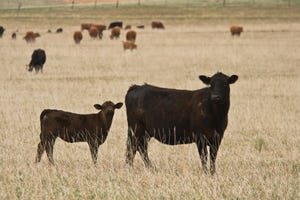
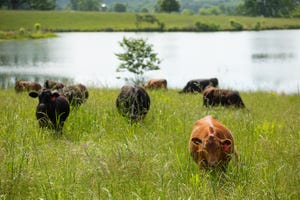
There was a time when Cope just walked through pastures and woods near Truxton, MO, admiring cattle. Now, increased weeds and brush force him to mount an ATV and ride around searching for them.

“I really just wanted to open it (pasture) up,” he says, “just get it back to the way it was.”

Instead of investing in hours of mowing or applying chemicals, Cope bought goats. Goats provide an ecologically sound and economically viable alternative for biological weed and brush control, says Mark Kennedy, State Grassland Conservationist with USDA's Natural Resource Conservation Service (NRCS).

“Goats are the species of choice for controlling brush in pastures, abandoned farmland and rangeland,” Kennedy says.

Cope adds: “Goats are little cows that eat something different. Goats will walk through beautiful grass and eat the weeds.”

Picky pasture eaters

Adding goats to cattle pastures diminishes browse plants, broad-leaf weeds and, in some cases, plants toxic to cattle.

While cattle are bulk grazers tending to be non-selective and graze for quantity rather than quality, goats are selective.

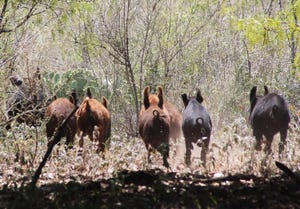
“They love blackberries and most small softwood trees like cedar and hickory,” Cope says. They also forage on poison ivy, poison oak, multiflora rose and buck brush.

In studies, goats reduced brush cover from 45% to 15% in one year, Kennedy explains. The same work found goats reduced brush cover down to 2% in five years.

Other studies found grazing goats practically eliminated multiflora rose after only four grazing seasons. Cope saw it first-hand on his farm.
“The goats will eat the leaves off and leave the cane. It will be gone next year,” he says.

Goats also do well grazing in the woods. Cope realized diminished undergrowth after introducing goats to wooded areas on the farm.

Goat-proof pastures

An investment in fencing is required, however. A lot of people complain about the cost of fencing, but Cope tells them “the cows didn't pay for the fence the first day, either.”

Cope's initial investment called for adding two electric wires to the established four-strand barbwire cattle fence. Removing the bottom barbwire strands, Cope added two electric wires.

“You could also put one electric wire along the bottom and one in between the first and second barbwire,” he says.

Kennedy says electric fence is often the most effective and least expensive option. He recommends a perimeter fence with 5-8 energized wires or woven wire with two strands of electric wire.

Both Cope and Kennedy agree producers considering woven wire should choose larger netting, either 9 or 12 in. “It helps prevent the goats from getting their heads stuck,” Cope says.

Producers can also purchase temporary fencing, allowing goats to rotationally graze a pasture or graze a specific heavy brush area. Cope, who says they're easy to set up and move, uses high-tensile wire to divide up larger pastures. “I'll move the goats through and then the cattle,” he adds.

Stocking for brush control

When stocking goats for brush control, Cope's rule of thumb is “one goat per cow.”

Kennedy agrees: “It's generally thought that, on good to excellent pasture, you can add one or two goats per cow without changing the cattle stocking rate due to differences in diet preference and grazing habits.”

Producers can clean up brush using only goats. “When using goats alone,” Kennedy says, “the stocking rate would be eight to 12 goats/acre, depending on brush density and how quickly you want to eliminate brush.”

When it comes to buying goats, Cope made a rookie mistake. “I bought all kids,” he laughs. “If I had to start over again, I'd buy mature females. They're already working for you and know what they're doing. Sometimes they're cheaper.”

More mature females also handle the kidding process better, Cope says. The result is more kids to sell.

Unexpected returns

Demand for goat meat is on the rise. The U.S. doesn't produce enough goat meat, instead relying on imports. In 2004, the U.S. imported 9,500 metric tons of goat meat, mostly Australian.

In states like Missouri, goat production is one of the fastest growing segments of the ag sector, increasing by 8% last year.

Cope raises Spanish meat goats and sells the kids to an order buyer.

“I call him and tell him how many I have, what they weigh, and what I want for them,” he says. The order buyer then comes and picks them up, cutting Cope a check on the farm.

Some growers also market on the Internet. “Several small producers can collectively pool their animals and attract more buyers via the Internet,” Kennedy says.

By adding goats to his cattle operation, Cope moved his brush clearing from the expense column to the income column. He generates income from kid sales, reduces cost in brush control, all while improving his cattle pastures.

Mindy Ward is a freelance agricultural writer based in Marthasville, MO.

Get Copyright Clearance Want to use this article? Click here for options!
© 2009 Penton Media Inc.

Browse Back Issues

BQS: View Details and Register Online!

American Cowman

www.AmericanCowman.com

Latest Jobs

Marketplace Ads

  • Hubbard Feeds, Inc

    Give us a call at (800)535-2428 to see if we can benefit your operation.

  • Hubbard Feeds, Inc

    Download free tools, sign-up for newsletters, browse nutrition products.

  • Your ad Here!

    Advertise your business here! Find out how.

  • Ag Maps for sale

    Ag Maps for Sale!

  • Livestock Markets

    The Place To Source Your Cattle and Horses.

Resources

  • Western Art Prints
  • Beef Quality Summit
  • 2007 Fencing Guide
  • 2008 Feed Composition Tables
  • Cattlemen's Calendar
  • Biosecurity
  • 2009 Alliance Yellow Pages
  • Estate Planning
  • Calf Health
  • RFID Suppliers
  • State of the Industry
  • Free Product Info
  • National Stocker Survey
  • Lets talk ag logo
  • National Stocker Survey