AmericanCowman.com - Dedicated to America's family cattle operations.

Most Recent

Cow Calf Weekly

Subscribe to our weekly newsletter... It's FREE!

Online Exclusives

Calving Tips

Hands-on, practical advice will make the calving season easier on you, and your herd


         Subscribe in NewsGator Online   Subscribe in Bloglines  

As calving season draws near, there's a myriad of situations ranchers find themselves in. Ron Skinner, DVM and seedstock breeder from Hall, MT, gives his advice for cattlemen during delivery.

What's the best way to check delivery progress?

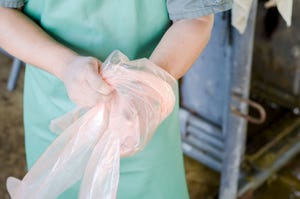
In checking a cow, the first thought is to determine if the calf is alive, as this may make a difference in your strategy. When you reach in to find the calf, a live calf generally will jerk its foot when you handle its legs or pinch the skin between its toes. You can also stick a finger in its mouth; a live calf will suck or gag.

On a backward calf, stick a finger in its anus to check muscle tone. “If the anal sphincter is completely flaccid, he's dead. If there's some muscle tone, he's still alive,” Skinner says.

Are there any special considerations when restraining a calving female?

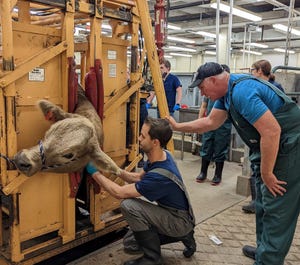
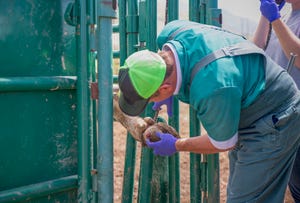
To check a cow or heifer, tie her up or restrain her in a headcatch that allows her to lie down without hanging by the head, with sides that swing away. It's easiest to check her and correct a malpresentation if she is standing, as there's more room to work inside her without the abdominal contents pressing against her uterus.

However, once you've determined the calf is in proper position, or you've corrected a malpresentation, it's best to lay the cow down when you pull the calf. She can strain more effectively that way, it's easier on both the cow and calf and gravity isn't working against you.

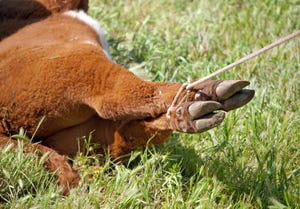
If she doesn't lie down once you've corrected a problem, put her on the ground by using a rope. Tie the rope loosely around her neck in a non-slip knot, then use the long end to make a half hitch around her girth (behind her shoulders) and another around her flanks, with the remainder behind her. Pull on it to tighten the half hitches, and the pressure will take her down.

“If she goes down and jumps back up, take your time and pull on the rope again, and soon she'll collapse without a big fight,” Skinner says.

“Some ranchers restrain a heifer in a slot in the barn or behind a panel, stick a pole behind her (because they don't have a good facility for restraint and don't know how to lay her down), and use a come-along hooked to the gate across the alley to pull the calf. Even if they hook it as low as possible, the angle isn't quite right, the heifer is hanging over the pole and the pressure is never let off. Ranchers kill some calves that would have survived if pulled properly,” he says.

Even when working alone, it's easier on the heifer (and better for the calf) if she's tied to a post in the pen.

What do I need to be careful of when pulling a calf?

Using lubricant around the calf can make pulling a dry calf easier, but be careful.

“There are some very good obstetrical lubricants, but one of the best can kill the cow if it spills from the uterus into the abdominal cavity if you end up having to do a C-section,” Skinner says. “So be fairly sure, when you begin pulling the calf, that surgical removal isn't necessary.”

One way to determine if a C-section is necessary is whether progress can be made with the strength of two people pulling when the cow is pushing. “If the calf isn't moving, even when you're going slowly and giving the cervix time to dilate, it means the calf is too big to come through,” Skinner says.

When pulling a calf, always pull when the cow is straining; rest when she rests. Don't put steady traction on the calf without periodic letup. It takes time for the cervix to dilate and the birth canal to stretch to its fullest capacity.

“In a normal birth, a cow doesn't just squirt a calf out in two minutes. She'll get up and down, and push and rest. The calf makes a little progress as she strains, then goes back in a little. The cow keeps stretching a little more, gets up and walks around and lies back down.

“So take your time when pulling the calf; if you only pull as the cow pushes, you don't need to pull as hard to get as much done. When she's not pushing, let the calf back,” Skinner says. Almost always, the cow will work with you as you pull, he adds, unless she's exhausted from trying too long before she was assisted.

Constant pulling puts constant pressure on the calf, impairing blood circulation. “This is one reason some calves are unconscious and fail to start breathing when born. If it's really tight in the birth canal (and you feel the calf's elbows pop when they enter the birth canal because it's so tight), and you are constantly pulling on its legs, which are tight against his head, then its legs are putting pressure on its jugular vein.

“When I have a tight one like that, I'll pull when the cow pushes, doing this 4 or 5 times; then I'll push the calf back to let it get circulation to its head. After giving the cow a little time to rest, with the calf pushed back inside (just like she'd be doing out in the field when she gets up and walks around), I'll pull it out again.

“Once its head is out of the vulva to its eyebrows, then you can finish pulling it — because the cow is now stretched enough for it to come. And when it gets out, it will usually breathe,” Skinner explains.

The calf isn't breathing — what should I do?

Most calves that don't start breathing (even those with a heartbeat) result from circulation to their heads being impaired too long. What stimulates the calf to breathe is the dropping level of oxygen in the bloodstream (as when the umbilical cord breaks, removing its constant supply of oxygen). This triggers the brain to tell the calf to breathe. “But if we've been pulling it with constant pressure, we've cut circulation off to the brain enough that this trigger isn't happening; we've made the calf brain dead,” Skinner says.

If you consistently allow a calf periodic relief from the pulling pressure, you'll rarely have a calf that won't breathe upon delivery. This may take a little longer, but it's safer for both the cow and calf. A calf doesn't have to breathe until its umbilical cord is squeezed off, which won't happen until his head and shoulders are out of the birth canal — unless he's coming backward.

How should I care for the cow after a hard pull?

Pulling a calf too fast (with unrelenting traction, either by hand or with a puller) is also more apt to put the cow at risk for a prolapsed uterus. “If you've taken a little time, working with the cow, the uterus will be contracting down behind that calf by the time you deliver the calf, and not so apt to turn inside out,” Skinner says.


Acceptable Use Policy
blog comments powered by Disqus

Get Copyright Clearance Want to use this article? Click here for options!
© 2009 Penton Media Inc.

Browse Back Issues

American Cowman

www.AmericanCowman.com

Latest Jobs

Marketplace Ads

  • Hubbard Feeds, Inc

    Give us a call at (800)535-2428 to see if we can benefit your operation.

  • Hubbard Feeds, Inc

    Download free tools, sign-up for newsletters, browse nutrition products.

  • Your ad Here!

    Advertise your business here! Find out how.

  • Ag Maps for sale

    Ag Maps for Sale!

  • Livestock Markets

    The Place To Source Your Cattle and Horses.

Resources

  • Western Art Prints
  • Beef Quality Summit
  • 2007 Fencing Guide
  • 2008 Feed Composition Tables
  • Cattlemen's Calendar
  • Biosecurity
  • 2009 Alliance Yellow Pages
  • Estate Planning
  • Calf Health
  • RFID Suppliers
  • State of the Industry
  • Free Product Info
  • National Stocker Survey
  • Lets talk ag logo
  • National Stocker Survey