Seedstock Newsletter Barn

Most Recent

Propose an Article!

Have an idea about an article or subject you'd like to see in BEEF? Submit a proposal!

Cow Calf Weekly

Subscribe to our weekly newsletter... It's FREE!

Online Exclusives

Recent Comments

Powered by Disqus

Carefully Consider A Backgrounding Decision


         Subscribe in NewsGator Online   Subscribe in Bloglines  

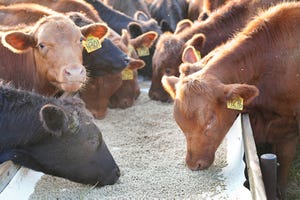
A drop in calf prices has some folks thinking about feeding their calves and selling the extra weight rather than marketing them this fall. But before you leap, a number of variables should be considered, says John Dhuyvetter, North Dakota State University (NDSU) Extension livestock specialist near Minot. Two to consider are feed costs and the anticipated marketing time.

While feed costs have moderated greatly recently, the effect of the early frost on corn prices is still unknown, Dhuyvetter says. Still, an early frost might create wet, immature corn that is lower priced and more suitable for cattle feed.

And, determining when to sell cattle depends on the type of cattle, available feed resources, prices, feeding performance and projected future market price that leads to the projected cost of gain (COG).

Using a simple breakeven calculator, such as the NDSU-developed "Calf Web" (available at www.chaps2000.com), can help evaluate feeding risks and potential.

  • For example, a 550-lb. steer weaned in late October would be marketed in late January at 750 lbs. with an average gain of 2 lbs./day. Assuming this will be achieved on a $70/ton ration at a 9:1 conversion, charging 30¢/head/day yardage, and assuming $10/veterinary costs, 1.5% death loss and 7% interest on the calf and feed, a sale price of $92.5/cwt. would be needed to break even. The resulting feed and yardage cost would be 46.5¢/lb. of gain and total COG would be 63¢.

  • For earlier born and growthy type calves, a shorter 45- to 60-day preconditioning period may get the calves ready to sell during higher seasonal markets for finished cattle. For example, a 600-lb. steer weaned in mid-October would reach 800 lbs. in mid-December at an average gain of 3 lbs./day for 65 days. This would result in a projected breakeven of 88.5¢ and a total COG of 57¢/lb.

  • Sometimes, later-born, smaller calves are weaned late in the fall and overwintered slowly to target summer grazing. These calves utilize forage in the winter and grass in the summer, then are finished for fall markets. Thus, 525 lb calves weaned in mid-November and wintered at 1.5 lbs./day of gain on a $60/ton ration results in 725-lb. feeders at the end of March with an associated 91.5¢ breakeven cost and a 68¢/lb. overall COG.
"If calf prices rally over the next few months, backgrounding will prove to be a very good choice," says Karl Hoppe, NDSU Extension livestock specialist in Dickinson, “but with the sluggish economy, calf prices may only maintain or could decrease."

For more info on weaning calves, backgrounding and related issues, visit www.ag.ndsu.edu/livestock/beef.html.
-- NDSU news release

Get Copyright Clearance Want to use this article? Click here for options!
© 2009 Penton Media Inc.


Acceptable Use Policy
blog comments powered by Disqus

Browse Back Issues

Interact with us:

BEEF Magazine on Facebook BEEF Magazine on Twitter

Marketplace Ads

  • Hubbard Feeds, Inc

    Give us a call at (800)535-2428 to see if we can benefit your operation.

  • Hubbard Feeds, Inc

    Download free tools, sign-up for newsletters, browse nutrition products.

  • Your ad Here!

    Advertise your business here! Find out how.

  • Ag Maps for sale

    Ag Maps for Sale!

  • Livestock Markets

    The Place To Source Your Cattle and Horses.

Resources

  • Western Art Prints
  • Beef Quality Summit
  • 2007 Fencing Guide
  • 2008 Feed Composition Tables
  • Cattlemen's Calendar
  • Biosecurity
  • 2009 Alliance Yellow Pages
  • Estate Planning
  • Calf Health
  • RFID Suppliers
  • State of the Industry
  • Free Product Info
  • National Stocker Survey
  • Lets talk ag logo
  • National Stocker Survey