Industry At A Glance: Kansas Cowherd Trends
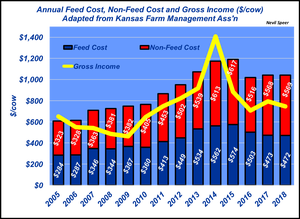
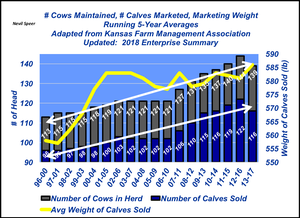
Kansas Farm Management Association data on five-year moving averages for three key metrics indicate that cow numbers and the number of calves marketed have hit a plateau in Kansas. The average marketing weight of those calves, however, has increased by 20-30 lbs./head. Is this Kansas data representative of the broader industry, and how has your operation changed and adapted over time?
Industry At A Glance: Annual Beef Cow Inventory & Cow-Calf Returns
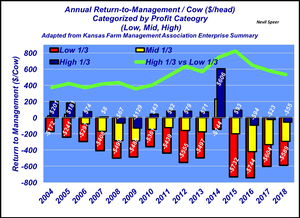
The latest U.S. cattle inventory report shows that the beef cowherd continues to shrink and has shed an average of 350,000 head annually for the past 17 years. With numbers down and calf prices up, the basic fundamentals are in place for heifer retention to begin in earnest. But, while prices have been high, they apparently haven’t been high enough. The ultimate question becomes, given the new operating dynamics, what level of return will be required to reverse this trend and encourage producers to begin rebuilding the cowherd?
Outlook: Some Thoughts On The Cargill Plant Closure
Tyson CEO Donnie Smith recently noted that his company is witnessing price resistance among consumers and some are trading down, away from beef to chicken. Only time will tell if that occurs in a significant way. If so, it will be translated fairly readily into the wholesale market and could provide a major challenge for this spring’s fed market. As such, risk management is especially warranted here.
Industry At A Glance: U.S. Cowherd Liquidation
U.S. beef cow numbers have shrunk by an average of 350,000 head/year for the past 17 years. Despite such a huge loss of breeding animals, the industry has proven able to compensate for fewer numbers with better genetics, improved management and better technology. But the industry is flirting with a liquidation mentality that could become self-perpetuating, which would prove very detrimental to the industry in the long term.
Industry At A Glance: Auction Market Volume
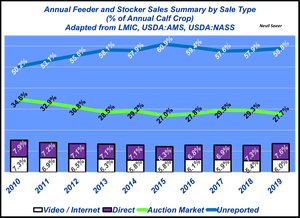
Data collected over the past 15 years in the state of Kentucky suggest that producers increasingly are exercising new or alternative methods to sell/market their cattle – e.g., utilizing video or direct sales vs. auction markets. What does this portend for auction marketing in the years to come?
Industry At A Glance: Beef Cow Inventory
Though the U.S. cattle inventory will likely show contraction again this year – the 17th consecutive year of fewer numbers – an increase in animal productivity has softened the blow. That continually shrinking inventory, however, poses severe challenges on the U.S. industry’s infrastructure and service industries.
Industry At A Glance: A Look At Feedyard Revenue
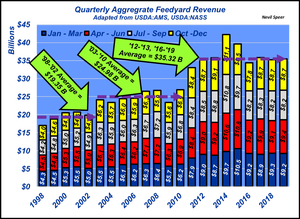
Total feedyard revenue is a function of live weight, the number of cattle marketed, and the overall market. Revenue in this sector declined in 2009 on the heels of the financial crisis that hit the U.S., as well as weaker markets. However, it’s come roaring back since then, surging nearly 50%. The question is: What’s in store for 2013?
Industry At A Glance: Out-Front Beef Sales Increasing
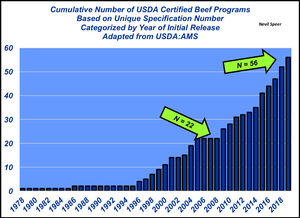
Market trends depict a growing proportion of branded beef sales over time. Another trend in the wholesale market is the increasing proportion of out-front sales of beef. The result is this segment – much like the live-cattle market – is utilizing the spot market less and less.
Industry At A Glance: Branded Beef Sales
The sales volume of branded beef products established a new mark (15%) in August, and the running average is nearly double that of just a few years ago. In a time of tightening beef supplies, this trend has important implications for the beef industry.
Industry At A Glance: Beef Export Values
Ractopamine is a feed additive that improves the feed efficiency, growth rate and lean carcass percentage of live hogs and cattle, and it is approved by FDA as safe for use. So Russia’s recent announcement that it will require all imported meat products to be certified free of ractopamine has caused some consternation to U.S. industries that increasingly depend on foreign demand for U.S. pork and beef products.
Industry At A Glance: Cropland & Pasture Values
What impact would the failure of the U.S. Congress to address the estate tax before Jan. 1 have on your business operations and estgate planning? Unless Congress acts, the federal estate tax will drop on Jan. 1 from the current $5-million individual exemption and 35% tax rate, to $1 million and a 55% tax rate. Most land-owning agriculturalists, who tend to be asset-rich but cash-poor, would be impacted by that change.
Outlook: World Awaits Resolution Of Fiscal Cliff
By the time you read this, perhaps some sort of meaningful resolution to the fiscal cliff negotiations might have occurred. We can only hope, but I’m not keeping my fingers crossed. In the meantime, count on some nervous markets and lots of volatility.
Industry At A Glance: Food Shopper Behavior
Final demand is critically important to any industry. The financial crisis and ensuing recession had a sharp outcome on consumer behavior, especially in the food-retailing sector.